
How to Select, Evaluate, and Import High-Performance Hemodialysis Catheter Kits: Technical Engineering, Biocompatibility, and Global Procurement Trends
An authoritative guide for medical equipment buyers, hospital procurement committees, nephrology clinical leads, and medical device importers on evaluating hemodialysis catheters, navigating EU MDR compliance, and leveraging Indian OEM manufacturing strengths.
1. Introduction: The Critical Role of Hemodialysis Catheter Kits in Vascular Access
In modern renal replacement therapy, establishing immediate, safe, and continuous vascular access is a cornerstone of end-stage renal disease (ESRD) and acute kidney injury (AKI) management. While arteriovenous fistulas (AVF) and arteriovenous grafts (AVG) remain the gold standards for long-term maintenance hemodialysis, temporary and long-term Hemodialysis Catheter Kits serve as indispensable life-saving central venous access devices. They allow immediate extracorporeal blood purification when emergency dialysis is required or while arteriovenous access is maturing.
For hospital procurement officers, medical device distributors, and Ministry of Health tender committees, sourcing high-grade Hemodialysis Catheter Kits involves evaluating complex fluid dynamics, polymer biocompatibility, sterility assurance, and strict regulatory compliance. A failure in catheter design can lead to devastating clinical outcomes, including catheter-related bloodstream infections (CRBSI), central venous thrombosis, vessel wall perforation, or high recirculation rates that compromise dialysis adequacy (Kt/V goals).
At Mediplus (Shree Umiya Surgical Pvt. Ltd.), backed by over 36 years of specialized manufacturing experience since 1988 in Ahmedabad, India, we engineer Hemodialysis Catheter Kits that solve these precise clinical challenges. By integrating medical-grade polyurethane elastomer technology, precision micro-moulding, and optimized lumen geometry, our hemodialysis catheters deliver superior flow rates with minimal vascular trauma.
2. Technical Architecture & Fluid Dynamic Engineering of Mediplus Dialysis Catheters
A high-performance Hemodialysis Catheter Kit must satisfy two contradictory physiological requirements: it must possess sufficient columnar strength for smooth percutaneous introduction via the Seldinger technique, yet remain soft and flexible within the vessel to prevent vascular irritation and thrombosis.
2.1 Thermo-Sensitive Polyurethane Polymer Formulation
Mediplus utilizes custom-formulated, medical-grade thermo-sensitive polyurethane (PU) for all central venous and hemodialysis catheters. Unlike rigid Polyvinyl Chloride (PVC) or soft but fragile Silicone, polyurethane offers distinct physical advantages:
- Rigid at Room Temperature (20°C–25°C): Facilitates crisp insertion over the guidewire without bucking, bending, or requiring excessive force during subcutaneous tract dilation.
- Softens at Body Temperature (37°C): Once advanced into the superior vena cava (SVC) or right atrium (RA), the catheter softens by over 40%, allowing the lumen body to gently conform to the natural curvature of the vein, drastically reducing mechanical trauma to the endocardium and vascular endothelium.
- Superior Tensile Strength & Wall Thinness: Polyurethane enables ultra-thin catheter walls while maintaining high burst pressures. This structural efficiency translates to larger internal lumen cross-sections for a given outer French size, significantly lowering flow resistance.
2.2 Minimizing Recirculation via Advanced Lumen Geometry
Extracorporeal blood flow rates during high-efficiency hemodialysis typically range from 300 mL/min to 400 mL/min. If processed blood returning through the venous lumen is immediately re-aspirated into the arterial lumen, blood clearance drops sharply. Mediplus engineers address this through precision lumen tip geometry:
Clinical Design Innovation: The Dual-D Cross-Section & Staggered Tip Configuration
Our double-lumen catheters feature a Dual-D lumen profile separated by a rigid internal septum. The arterial intake port is placed 20 mm to 25 mm proximal to the venous exit tip. This physical separation prevents turbid arterial suction of freshly dialyzed blood, maintaining clinical recirculation rates consistently below 2.5% under standard blood flow conditions.
2.3 Kit Component Synergy: The Complete Seldinger System
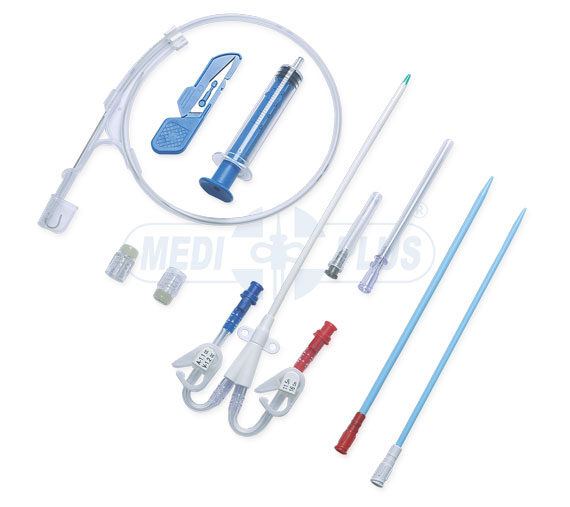
A reliable catheter is only as good as the insertion kit surrounding it. Every component within the Mediplus Hemodialysis Catheter Kit is engineered for seamless mechanical compatibility:
- Echogenic Introducer Needle: Engineered with a bevelled micro-point tip and ultrasonic reflection grooves for clear real-time visualization under bedside ultrasound guidance during jugular or femoral access.
- PTFE-Coated Nitinol Guidewire with J-Tip: High kink resistance with a flexible J-tip deflector prevents vessel intima damage during venous entry, while depth indicators assist precise guidewire advancement.
- Progressive Vessel Dilators: Made from lubricious high-density polyethylene (HDPE) with tapered transition tips to dilate subcutaneous tissues without tearing the skin or traumatizing the central vein.
- Suture Wings & Extension Clamps: Soft silicone rotatable suture wings provide secure anchoring to reduce catheter migration. Color-coded extension lines (Red for Arterial suction, Blue for Venous return) come equipped with heavy-duty click clamps tested to withstand over 500 clamping cycles without wall cracking.
3. Comprehensive Product Specification Matrix & Recommended Configurations
Mediplus offers an extensive portfolio of acute and chronic hemodialysis catheter kits tailored to pediatric, adult, and high-volume dialysis protocols. The table below outlines our standard production options for global procurement requirements.
| Catheter Type | French Size (Fr) | Length Options (cm) | Lumen Design | Flow Rate Capacity | Primary Clinical Application |
|---|---|---|---|---|---|
| Acute Double Lumen | 11.5 Fr / 12 Fr | 13 cm, 15 cm, 20 cm | Dual-D Section | 300 – 350 mL/min | Emergency AKI Dialysis, Short-term ICU access (Jugular/Subclavian) |
| Acute Double Lumen (Femoral) | 11.5 Fr / 12 Fr / 14 Fr | 25 cm, 30 cm | Dual-D Section | 350 – 400 mL/min | Femoral access in bedridden or acute dialysis patients |
| Pediatric Double Lumen | 7 Fr / 8.5 Fr | 8 cm, 11 cm, 15 cm | Coaxial / Side-by-Side | 100 – 200 mL/min | Pediatric and infant acute renal support |
| High-Flow Triple Lumen | 12 Fr / 14 Fr | 15 cm, 20 cm, 25 cm | Triple-Chamber | 350 – 450 mL/min | High-flux hemodialysis with dedicated central line infusion port |
| Chronic Tunneled Cuff | 14.5 Fr | 28 cm, 32 cm, 36 cm, 40 cm | Step-Tip / Split-Tip | 400 – 450 mL/min | Long-term access with Dacron cuff for tissue ingrowth & infection bar |
4. Product Trends & Future Outlook in Hemodialysis Access Devices (2026–2030)
As the global burden of Chronic Kidney Disease (CKD) rises—projected to become the 5th leading cause of death worldwide by 2040—the demand for advanced hemodialysis disposables is expanding rapidly. Based on market intelligence and clinical user feedback from over 70 export destinations, Mediplus identifies key trends shaping the future of vascular access procurement:
4.1 Integration of Bio-Active and Antithrombotic Surface Coatings
Catheter thrombosis and bio-fouling remain major causes of hemodialysis catheter failure. Future procurement trends indicate a shift toward catheters integrated with hydrophilic and antithrombotic surface coatings (such as heparin-bonded or zwitterionic polymer coatings). These technologies inhibit fibrin sheath formation and platelet adhesion, extending catheter patency and drastically reducing the need for costly tissue plasminogen activator (tPA) instillations.
4.2 Paradigm Shift Toward Ultrasound-Guided Procedure Kits
Regulatory authorities such as the National Institute for Health and Care Excellence (NICE) and the US FDA strongly recommend ultrasound guidance for all central venous catheterizations. Hospital procurement departments are moving away from basic catheter packs toward "All-in-One Safety Kits" that include echogenic needles, depth-marked nitinol guidewires, safety scalpels, and chlorhexidine gluconate skin preparation sets to eliminate procedural complications.
4.3 Geopolitical Supply Chain Realignment and the Rise of India as a Manufacturing Hub
Global medical device supply chains are actively diversifying away from traditional single-source countries to mitigate geopolitical risks and tariff fluctuations. India has emerged as the premier global manufacturing hub for medical disposables, offering World Health Organization (WHO)-compliant cleanroom manufacturing, highly skilled biomedical engineering talent, and competitive production cost structures without compromising European MDR quality benchmarks.
5. Enterprise Strengths & E-E-A-T Principles: Why Partner with Mediplus (Shree Umiya Surgical Pvt. Ltd.)
When procurement executives evaluate medical device suppliers, technical specifications are only half the equation—manufacturing integrity, regulatory transparency, and supply chain reliability are equally critical. Mediplus delivers proven corporate credentials built over nearly four decades of clinical manufacturing excellence.
5.1 Uncompromised Manufacturing Infrastructure & In-House Integration
Located in the Vatva industrial zone of Ahmedabad, Gujarat, India, our state-of-the-art manufacturing plant operates vertically integrated production lines spanning medical granule compound compounding, precision catheter extrusion, injection moulding, tip forming, assembly, and packaging.
- ISO Class 7 & Class 8 Cleanrooms: Controlled environmental assembly preventing particulate contamination and keeping initial bioburden levels well below regulatory limits.
- 100% In-Line Dimensional & Leak Testing: Every catheter lumen undergoes automated pressure decay testing and visual dimensional verification to guarantee leak-free performance.
- Sustainable Solar-Powered Operations: Mediplus facility features clean rooftop solar energy generation, making our medical disposable production highly sustainable and environmentally responsible.

5.2 Rigorous Regulatory Assurance and Technical Documentation
Registering medical devices with Ministries of Health (MoH) requires flawless technical documentation. Mediplus maintains complete, audit-ready technical dossiers under the European Union Medical Device Regulation (EU MDR 2017/745):
- Quality Management Certifications: ISO 13485:2016 and ISO 9001:2015 fully certified.
- Biocompatibility Validation: Full testing compliance with ISO 10993 standards (Cytotoxicity, Systemic Toxicity, Hemocompatibility, Sensitization, and Intracutaneous Reactivity).
- Sterilization Validation: Ethylene Oxide (EO) sterilization processes validated according to ISO 11135, ensuring Sterility Assurance Levels (SAL) of 10⁻⁶ with strictly controlled EO residue levels.
- Export Dossier Support: Provision of Free Sale Certificates (FSC), Certificate of Analysis (CoA) per batch, stability study data, and legalised apostilled documents for rapid MoH registration across Latin America, the Middle East, Africa, CIS, and Southeast Asia.
6. Frequently Asked Questions (FAQ) for Global Procurement & Sourcing Officers
Below are detailed technical and commercial answers to the questions hospital buyers and OEM partners frequently ask our export engineering team.
Mediplus Hemodialysis Catheters are extruded using medical-grade thermo-sensitive polyurethane (PU). This advanced polymer provides high structural rigidity at room temperature (20°C–25°C) to facilitate crisp percutaneous insertion via the Seldinger technique without buckling or bending. Once placed inside the human body at body temperature (37°C), the polyurethane softens significantly, conforming seamlessly to the vascular anatomy to minimize mechanical friction, vein irritation, and vessel wall perforation.
Our double-lumen hemodialysis catheters feature optimized internal septum designs—such as D-shaped dual lumens or coaxial configurations—that maximize arterial intake and venous return cross-sectional areas. The arterial lumen intake port is placed approximately 20 mm to 25 mm proximal to the venous exit tip. This spatial segregation ensures that purified blood returned through the venous port is not immediately re-aspirated into the arterial port, keeping recirculation rates consistently below 2.5% even under elevated blood flow rates (300–400 mL/min).
Each fully integrated Mediplus Hemodialysis Catheter Kit contains:
- 1 Radiopaque Polyurethane Hemodialysis Catheter (Straight or Curved extensions)
- 1 Nitinol or Stainless Steel PTFE-coated Guidewire with J-Tip Deflector and Advancer
- 1 Echogenic Introducer Needle / Valved Syringe
- 2 Vessel Dilators (progressively sized for smooth tissue expansion)
- 1 Scalpel with Ergonomic Handle (#11 blade)
- 2 Injection Site Caps (Luer-lock needleless valves)
- 1 Suture Wing with Fastener Clamp
- Optional items: Nitrile Gloves, Gauze Sponges, and Sterile Surgical Drapes upon custom request.
Mediplus Hemodialysis Catheter Kits are manufactured by Shree Umiya Surgical Pvt. Ltd. under a quality management system certified to ISO 13485:2016 and ISO 9001:2015. Product lines carry CE certification under European MDR standards and comply with ISO 10993 biocompatibility testing, ISO 10555 vascular catheter performance standards, and strict Ethylene Oxide (EO) sterilization residue limits per ISO 11135.
Yes, we provide comprehensive OEM and private-label manufacturing services for healthcare brand owners. Buyers can customize catheter French sizes (7 Fr to 16 Fr), lumen configurations (single, double, triple lumen), catheter length options (11 cm to 30 cm), extension line printing, multilingual Instructions for Use (IFU), UDI-compliant barcodes, and customized sterile blister trays or peel pouches.
All kits are sterilized using validated Ethylene Oxide (EO) cycles in accordance with ISO 11135 standards. The sterilize-in-pack validation ensures a 5-year shelf life when stored in original unopened blister packaging under recommended dry, cool ambient conditions.
For standard catalogue Mediplus branded catheter kits, the MOQ starts at 500 units per SKU. For custom OEM or private-label orders requiring customized packaging artwork, the initial MOQ is typically 1,000 units. Production lead times average 3 to 4 weeks from order confirmation, with export shipping handled via Mundra or Nhava Sheva ports under FOB, CIF, or CFR terms.