

Evaluating Foley Balloon Catheters for Clinical Excellence and Supply Chain Resilience
Navigating technical material parameters, regulatory certifications, and factory-level quality controls when sourcing critical urological disposables.
In modern urological care and critical intensive care units (ICU), the Foley Balloon Catheter remains one of the most widely deployed invasive medical devices. Designed for indwelling urinary drainage, this flexible tube is inserted through the urethra into the urinary bladder, held firmly in place by a symmetrical balloon inflated with sterile water. Despite its ubiquitous presence in clinical settings worldwide, healthcare procurement directors, Ministry of Health (MOH) tender committees, and medical device distributors face complex challenges when evaluating potential OEM suppliers and factory lines.
With increasing scrutiny regarding Catheter-Associated Urinary Tract Infections (CAUTI), regulatory shifts under the European Union Medical Device Regulation (EU MDR 2017/745), and the need for cost-efficient supply chain resilience, sourcing decisions must be backed by verifiable empirical data. This comprehensive B2B technical guide breaks down the critical parameters of Foley Balloon Catheter selection, manufacturing engineering, material choices, future technological trends, and supplier audit criteria.
Evaluating a Foley Balloon Catheter manufacturer requires verifying raw material biocompatibility (ISO 10993), balloon inflation symmetry, non-return valve reliability, and Ethylene Oxide (EO) sterilization residue thresholds (ISO 10993-7). Choosing an established manufacturer like Mediplus India guarantees batch-to-batch traceability and compliance with global clinical standards.
1. Technical Classification & Material Considerations
When issuing RFQs (Request for Quotations) or preparing international public tenders, procurement officers must accurately define the structural and material specifications required by clinicians. Foley balloon catheters are categorized primarily by lumen configuration, material composition, and clinical duration.
A. 2-Way vs. 3-Way Foley Balloon Catheters
- 2-Way Foley Catheter: Features two channels along its length. The primary lumen drains urine into a collection bag, while the secondary inflation channel allows sterile water injection to inflate the retention balloon. Ideal for standard short-term and long-term urinary retention management.
- 3-Way Foley Catheter: Incorporates an additional continuous irrigation lumen. This third channel enables saline or medicinal flushes directly into the bladder, preventing blood clot formation following transurethral resection of the prostate (TURP), bladder surgery, or severe hematuria.
B. Material Engineering: Silicone-Coated vs. 100% All-Silicone
Material selection directly dictates tissue reactivity, encrustation risk, and maximum permissible indwelling times:
| Technical Parameter | Silicone-Coated Latex Catheters | 100% All-Silicone Catheters |
|---|---|---|
| Base Material | Medical-grade natural latex core coated with medical silicone fluid | Translucent, medical-grade solid silicone elastomer |
| Indwelling Duration | Short-term (Up to 7 to 14 days) | Long-term (Up to 30 days or longer) |
| Tissue Biocompatibility | Good; reduced latex allergen exposure via silicone outer barrier | Superior; non-reactive, completely latex-free, minimal inflammation |
| Lumen Efficiency | Standard internal diameter | Wider internal lumen due to thin-wall design, maximizing flow rate |
| Clinical Target | General wards, post-op drainage, cost-sensitive hospital supply | Latex-sensitive patients, long-term care facilities, specialized urology |
2. Engineering Integrity: The Anatomy of a High-Performance Foley Catheter
A failure in catheter integrity—such as asymmetric balloon expansion, premature deflation, or luminal collapse—can cause severe urethral trauma or necessitate painful emergency extraction. High-caliber manufacturers enforce rigorous quality metrics across every component:
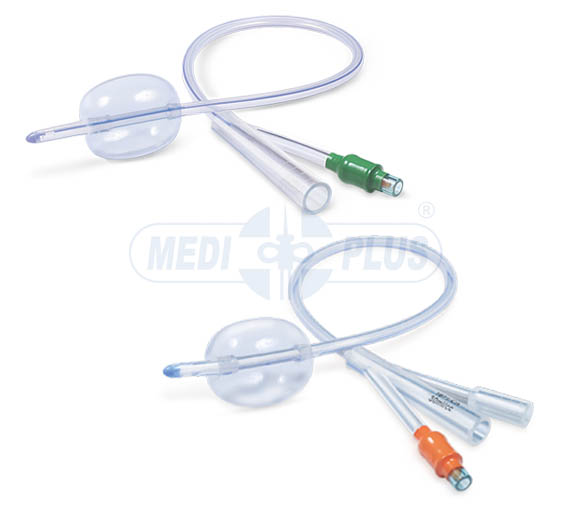
- Symmetrical Balloon Geometry: Upon inflation with sterile water, the balloon must expand uniformly around the shaft. Asymmetrical expansion skews the tip within the bladder neck, leading to localized tissue necrosis, discomfort, and incomplete drainage. Mediplus subjects 100% of manufactured balloons to stress-inflation testing prior to packaging.
- Atraumatic Smooth Eyes: Drainage eyes are punch-formed and bevel-finished using micro-thermal polishing. Sharp or rough eyelet edges lacerate delicate urethral mucosa during insertion, establishing entry points for bacterial colonization.
- Color-Coded Non-Return Valve: The inflation valve must maintain an airtight seal against pressure loss over weeks of use while remaining compatible with standard Luer-lock syringes. Color coding matches international French size (Charriere) standards for immediate clinical recognition.
- Kink-Resistant Drainage Shaft: Extruded with optimum shore hardness, the main shaft resists structural collapse under negative pressure or patient movement, ensuring uninterrupted urinary flow.