
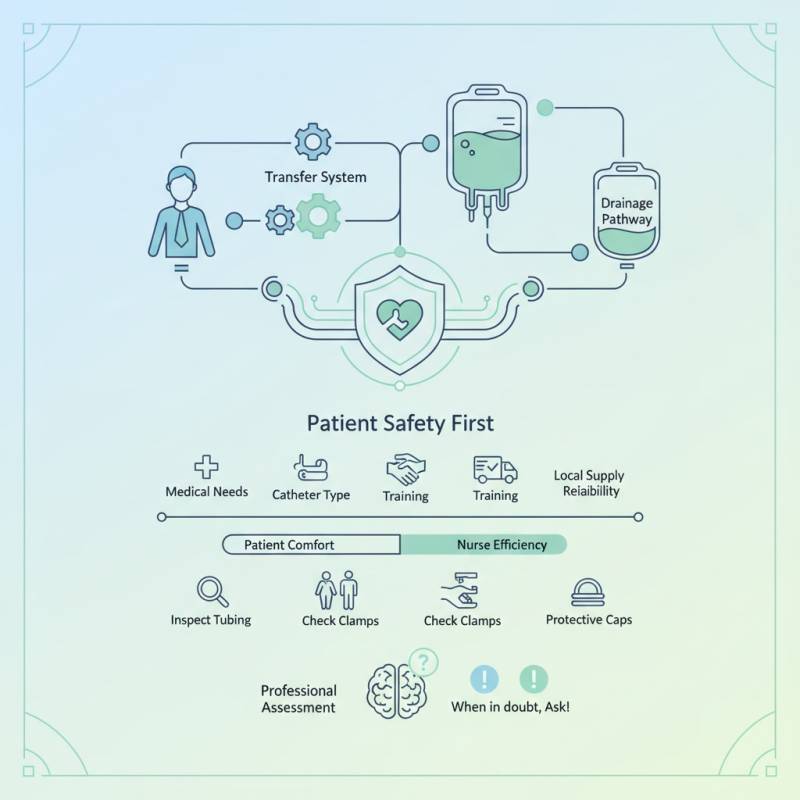
Choosing the right Peritoneal Dialysis Set is a clinical decision, not a simple product comparison. The set connects the patient, transfer system, solution bag, and drainage pathway. Each connection must fit correctly, remain sterile, and support the prescribed dialysis method.
Dr. Joanne Bargman, a respected peritoneal dialysis specialist, is often associated with this practical principle: “Patient safety must remain the first priority in dialysis care.” That principle should guide every selection. A suitable set must match the patient’s catheter type, connector system, exchange technique, and treatment plan. It should also be compatible with the prescribed dialysis solution and the equipment used at home or in the clinic.
Small details matter. Check the clamp movement. Inspect the tubing for kinks. Confirm that protective caps are sealed and undamaged. A clear package does not guarantee correct compatibility. Nor does a familiar brand eliminate the need for checking.
Patients may value soft tubing and simple handling. Nurses may focus on secure connections and efficient drainage. Manufacturers may emphasize design improvements. All views matter, but none replaces professional assessment. A mistake here can interrupt treatment or increase infection risk.
There is no universal “best” Peritoneal Dialysis Set. The ideal choice depends on medical needs, catheter design, training, and local supply reliability. Sometimes, the most expensive option is not the most suitable. Sometimes, a small connector detail is overlooked.
Before use, the nephrology team should verify the complete setup. Product instructions, sterility information, and compatibility data deserve careful review. When uncertainty remains, pause and ask. That pause may protect the entire treatment process.
The right peritoneal dialysis set begins with the prescription, not the packaging. CAPD uses manual exchanges during the day. APD uses a cycler, usually overnight, with several programmed exchanges. The Global Kidney Health Atlas reported that peritoneal dialysis represented about 11% of global dialysis treatment in its international survey. That figure reflects wide differences in access, training, and clinical practice.
For many adults, a typical fill volume ranges from 1.5 to 3 L. A smaller volume may suit a new patient, a smaller body size, or limited tolerance. Larger volumes can improve clearance, but they may increase pressure, discomfort, or leakage risk. The 2022 International Society for Peritoneal Dialysis recommendations support individualized prescriptions based on residual kidney function, body size, transport characteristics, and treatment goals. A 2 L fill is common, but “common” is not the same as “correct.”
CAPD sets should match the prescribed exchange volume and connection method. APD sets must match the cycler program, tubing configuration, and overnight schedule. Small mismatches can create practical problems. I would not choose a set from volume alone. Nurses often notice details that a specification sheet misses, such as drain comfort or connection handling. Prescriptions also change. A patient may need less fluid after adaptation, or more clearance later. Reassessment matters. Personally, I would leave room for that uncertainty.
Choosing a peritoneal dialysis set starts with matching dialysate strength to the patient’s fluid needs. A 1.5% dextrose solution contains about 15 grams per litre and often suits routine exchanges when fluid removal is modest. A 2.5% solution provides approximately 25 grams per litre and may support greater ultrafiltration. The 4.25% option contains about 42.5 grams per litre, making it a stronger short-term choice for significant fluid overload. These concentrations can affect blood glucose, sodium balance, and daily calorie exposure.
The International Society for Peritoneal Dialysis recommends limiting unnecessary glucose exposure and reviewing the prescription regularly (ISPD Practice Recommendations, 2022). KDOQI guidance also stresses individual assessment of volume status, residual kidney function, and metabolic risks (KDOQI Clinical Practice Guideline, 2020). A higher percentage does not automatically mean better treatment. It may remove more water, but repeated use can increase thirst, hyperglycemia, and membrane stress. Clinical data can look tidy; real patients are not. Home weight records and drainage volumes sometimes tell a different story.
Tips: Check morning weight, blood pressure, swelling, and drain volume consistently. Never change concentration without medical guidance. Ask whether the 4.25% bag is needed for one exchange or a longer period. Review glucose readings, especially if diabetes is present. Reconsider the plan when ultrafiltration falls, cramps appear, or breathing becomes difficult. The “strongest” bag can be the wrong fit.
How to Choose the Right Peritoneal Dialysis Set?
Verify Catheter and Connector Compatibility Before Selecting the Set
Peritoneal dialysis depends on a continuous sterile pathway from the catheter to the solution bag. A set may appear suitable, yet its connector can have a different diameter, locking method, or rotation design. Confirm the catheter type, transfer-set model, connector geometry, and prescribed fill volume. Do not rely on appearance alone.
The USRDS 2023 Annual Data Report recorded peritoneal dialysis as the initial treatment for about 12% of new U.S. ESKD patients in 2021. Every connection therefore deserves careful checking. In practice, compare the product instructions with the catheter record before opening sterile packaging. Check whether the connection requires a screw lock, push-fit mechanism, protective cap, or dedicated disinfection step. Never force a tight connection.
Small mismatches matter.
The ISPD 2022 peritonitis recommendations identify a target rate below 0.40 episodes per patient-year for dialysis programs. Correct compatibility supports infection prevention, but it cannot replace hand hygiene, aseptic technique, staff training, and routine monitoring. A rushed visual match can feel sufficient; it is not. If the catheter history is incomplete, pause and ask the prescribing renal team or qualified dialysis nurse. The safer choice may take longer. That hesitation is worth documenting, especially when components come from different supply systems or the patient has recently undergone catheter revision.
Verify catheter and connector compatibility before selecting the set.
The chart summarizes the main compatibility attributes to verify at each connection point: connector geometry, locking or secure-connection mechanism, sterile connection method, and flow-path suitability. Always confirm the catheter specifications and the set instructions for use before connection.
How to Choose the Right Peritoneal Dialysis Set?
A sterile design deserves priority when selecting a peritoneal dialysis set. The ISPD target is below 0.40 peritonitis episodes per patient-year. This figure is a quality benchmark, not a promise. Every connection matters.
Look for sealed components, intact protective caps, tamper-evident packaging, and clear expiration dates. Smooth surfaces can reduce fluid residue and simplify disinfection. A well-designed connector should support a controlled, repeatable connection technique. It should also reduce unnecessary handling during exchanges. Small details matter. A loose cap does not.
Clinical teams should assess the set with trained staff before routine use. Review connector compatibility, instructions, visibility, and ease of use under normal lighting. Observe a complete exchange, including hand hygiene, clamp control, and disposal. Record near misses, damaged packages, and contamination concerns. These details provide stronger evidence than packaging claims alone.
Sterility depends on more than the product. Storage conditions, transport, patient training, and home cleanliness also affect infection risk. A sterile set cannot correct every procedural weakness. That limitation deserves honest attention. Even experienced users can rush during fatigue or interruptions. Regular competency checks and peritonitis-rate audits can reveal patterns early. Local protocols and current ISPD recommendations should guide the final decision.
| Selection Dimension | Evidence-Based Requirement or Benchmark | Why It Matters for Peritonitis Prevention | What to Verify Before Selection |
|---|---|---|---|
| Peritonitis performance target | Use a program-level target of fewer than 0.40 peritonitis episodes per patient-year, consistent with the ISPD quality-improvement target. Lower rates, such as below 0.20 episodes per patient-year, are considered desirable where achievable. | Provides a measurable outcome for evaluating the complete dialysis process, including the set, training, exit-site care, and infection surveillance. | Confirm that the dialysis service calculates episodes per patient-year consistently and reviews results at least annually. |
| Sterile barrier integrity | The fluid pathway and all critical connection components should be sterile, sealed, and protected by intact primary packaging until use. Sterilization validation should follow applicable medical-device standards. | A compromised package, seal, or fluid pathway can introduce microorganisms before treatment begins. | Check the sterilization method, sterility assurance information, package seal, expiry date, lot traceability, and instructions for handling damaged packaging. |
| Aseptic connection design | Prefer a closed or protected connection system that minimizes exposure of sterile connectors to hands, clothing, surfaces, dust, and environmental contamination. | Most contamination risk occurs during connection and disconnection. Reducing open manipulation supports consistent aseptic technique. | Review the number of connection steps, required protective caps, touch-free features, connector protection, and compatibility with the prescribed transfer device. |
| Touch contamination control | Critical sterile surfaces should not require direct hand contact. The set should provide clear separation between clean handling areas and connection points. | Touch contamination is a recognized pathway for organisms to enter the peritoneal dialysis system. | Assess whether the design supports touch-free handling, whether protective caps are easy to identify, and whether the instructions clearly define contamination events. |
| Disinfection compatibility | The connection system should be compatible with the disinfectant, exposure time, and technique specified in the clinical protocol. Do not substitute disinfectants without clinical approval. | Insufficient contact time or an incompatible disinfectant may leave microorganisms on connection surfaces. | Verify disinfectant compatibility, required drying time, storage conditions, and staff training requirements in the instructions for use. |
| Connector compatibility | All components must be mechanically and functionally compatible with the patient’s transfer set, cycler tubing, solution container, and prescribed treatment method. | Poor fit can cause leaks, disconnections, incorrect assembly, or accidental contamination during treatment. | Confirm connector standards, locking behavior, leak resistance, and compatibility testing for the complete configuration used by the dialysis unit. |
| Leak and flow control | Tubing, clamps, seals, and connections should maintain integrity under the intended pressure, flow, temperature, and dwell conditions. | Leaks can permit fluid loss, interrupt therapy, and create opportunities for environmental contamination. | Review validated flow direction, clamp visibility, leak testing, tubing kinks, and procedures for responding to a suspected leak or disconnection. |
| Clear fluid-path visibility | The set should allow inspection of effluent clarity, fibrin, blood, air, and unusual particles without unnecessarily opening the sterile pathway. | Cloudy effluent may be an early sign of peritonitis and requires prompt clinical assessment. | Confirm that tubing and collection sections are transparent enough for visual inspection and that abnormal findings trigger the local clinical pathway. |
| Safe packaging and storage | Packaging should protect the sterile barrier from moisture, puncture, crushing, excessive heat, and freezing throughout transport and storage. | Damage or improper storage can compromise sterility and material performance before use. | Check storage temperature limits, humidity restrictions, package inspection instructions, expiration dating, and stock-rotation procedures. |
| Instructions for use | Instructions should provide a complete sequence for hand hygiene, workspace preparation, connection, disconnection, contamination response, disposal, and emergency contact. | A technically sterile set cannot compensate for unclear or inconsistent handling procedures. | Use plain language, diagrams, local-language materials where needed, and competency checks for patients and caregivers. |
| Training and human factors | Select a design that patients can use correctly and consistently, including people with reduced vision, limited dexterity, or cognitive burden from complex procedures. | Usability problems increase procedural errors and may lead to touch contamination or incomplete disinfection. | Conduct supervised return-demonstration training and periodically reassess technique, especially after peritonitis, hospitalization, or equipment changes. |
| Peritonitis recognition criteria | ISPD diagnostic guidance generally uses at least two of three findings: compatible clinical features, effluent white-cell count above 100 cells/µL after a dwell of at least 2 hours with more than 50% polymorphonuclear cells, and a positive dialysis-effluent culture. | Early recognition and treatment can reduce complications and support accurate infection-rate reporting. | Ensure the set and workflow permit prompt effluent sampling and that patients know to report cloudy effluent, abdominal pain, fever, or nausea immediately. |
| Quality monitoring | Track peritonitis episodes using a consistent denominator: total episodes divided by total patient-years of peritoneal dialysis exposure. | Standardized measurement shows whether changes in equipment, training, or technique are associated with improved outcomes. | Record episode date, organism, possible contamination event, treatment outcome, technique retraining, and monthly or quarterly rate trends. |
Choosing a peritoneal dialysis set requires more than checking tube length or price. Look for clear device identification, intended use, sterile status, and applicable medical-device standards. Requirements may differ by country, so confirm them with a dialysis nurse or qualified healthcare professional. The instructions should explain connection steps, storage conditions, and disposal procedures in plain language.
Inspect the packaging carefully. It should be sealed, dry, undamaged, and free from unexpected wrinkles, punctures, or broken seals. Check the expiry date and product information before opening. Do not use a set if the package looks compromised. A clean-looking box can still hide damage. This is an easy detail to underestimate.
Home use adds practical concerns. Can the tubing be handled without sharp bends? Are the connectors easy to identify under normal room lighting? Does the set fit your prescribed equipment and daily routine? During training, practice opening the package, arranging the lines, and maintaining a clean work surface. Small frustrations matter. A setup that seems simple in a clinic may feel awkward beside a bed or kitchen table. Ask the care team to review your technique, especially if labels are difficult to read or instructions feel incomplete. Convenience should never replace compatibility, sterility, or professional guidance.
The prescribed strength should match your fluid needs, blood glucose, and overall health. A lower strength may suit routine exchanges. Higher strengths may remove more water.
A 1.5% solution contains about 15 grams of dextrose per litre. A 2.5% solution contains about 25 grams. A 4.25% solution contains about 42.5 grams.
No. A stronger solution may help during significant fluid overload. Repeated use can increase thirst, high blood glucose, and membrane stress. Stronger is not automatically better.
Record morning weight, blood pressure, swelling, and drainage volume. Check glucose readings when advised, especially with diabetes. Small changes can matter.
No. Never change concentration without professional guidance. Ask whether a stronger bag is needed for one exchange or longer use.
Compare the catheter type, transfer set, connector shape, locking method, and prescribed fill volume. Do not trust appearance alone. Never force a tight connection.
Pause before opening sterile packaging. Contact the prescribing renal team or a qualified dialysis nurse. A short delay is safer than a guessed connection.
Check the seal, expiry date, product information, and package condition. Avoid sets with punctures, moisture, broken seals, or unusual wrinkles. A clean box can still contain damage.
Tubing should avoid sharp bends, and connectors should remain easy to identify. Practice on a clean surface before treatment. Real homes can be awkward.
Seek professional review if fluid removal falls, cramps appear, swelling worsens, or breathing becomes difficult. Your weight records may challenge the original plan. That is worth discussing.
Choosing the right Peritoneal Dialysis Set begins with confirming the treatment prescription. Determine whether the patient uses continuous ambulatory peritoneal dialysis (CAPD) or automated peritoneal dialysis (APD), and verify the prescribed fill volume, commonly within the 1.5–3 L range. Dialysate strength should also match the clinical plan: 1.5%, 2.5%, and 4.25% dextrose solutions may be selected according to fluid removal needs, blood glucose considerations, and professional guidance.
Before purchase or use, confirm that the set is compatible with the patient’s catheter, transfer components, and connection system. A sterile, well-sealed design is essential for reducing contamination risk and supporting the ISPD target of fewer than 0.40 episodes per patient-year. Users should inspect device standards, expiration dates, labeling, and packaging integrity, rejecting any set that appears damaged or compromised. For home treatment, practical features such as clear instructions, manageable handling, secure connections, and convenient disposal can improve confidence and support consistent, safe use.